
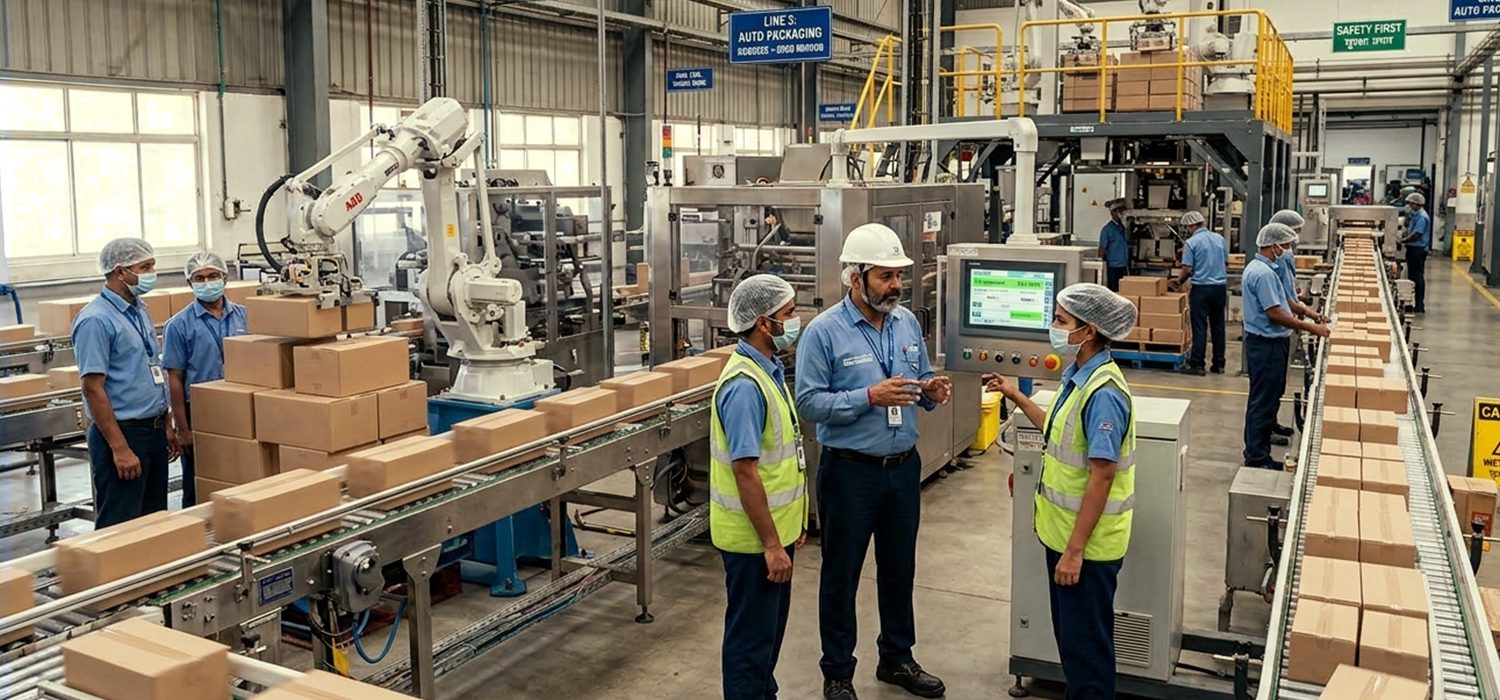
Is growth in FMCG proclaimed or constructed?
Behind every increase in market share, every new distribution footprint, and every expansion into emerging demand clusters lies a foundational decision: capacity expansion. Yet in disciplined organisations, expansion is not a reaction to momentum. It is a structured response to visibility, demand stability, and long-term strategic intent.
Capacity expansion in FMCG is less about scale for its own sake and more about readiness.
What Capacity Expansion Truly Means
Capacity expansion, in simple words, refers to increasing a company’s production capability. In practice, it is more nuanced.
It may involve:
- Additional production lines
- Upgrading existing machinery for higher throughput
- Expanding warehousing as well as logistics infrastructure
- Strengthening backward integration and sourcing networks
- Investing in automation and technology systems
True capacity expansion is not only about producing more units but also about more efficient, consistent, and resilient production processes.
In high-volume consumer categories, the ability to react swiftly to changes in demand caused by seasonality, regional, or structural factors defines competitive strength. For this reason, expansion must be aligned with demand predictability and operational discipline.
Why Capacity Expansion Matters in FMCG
1. Demand Volatility Requires Structural Readiness
India’s consumption landscape is increasingly dynamic. Urban premiumisation, rural resurgence, regional preferences, and channel diversification through e-commerce and quick commerce create fluctuating demand patterns.
Even strong brands that lack adequate production bandwidth run the risk of supply gaps. And in FMCG, shelf absence means lost loyalty. And capacity expansion ensures continuity.
2. Economies of Scale Protect Margins
Larger, optimised facilities reduce per-unit production costs through:
- Better fixed cost absorption
- Improved procurement leverage
- Lower logistics inefficiencies
- Enhanced automation benefits
When executed responsibly, expansion strengthens both top-line growth as well as bottom-line stability.
3. Governance and Compliance Are Scaling Factors
Modern FMCG growth requires adherence to stringent quality, food safety as well as environmental standards. Expanding capacity within a controlled, system-led framework ensures compliance scales alongside output.
Unstructured growth often exposes governance gaps. Structured expansion reinforces credibility.
How Capacity Expansion Is Executed Responsibly
Disciplined expansion follows a phased and data-backed approach.
Demand Visibility Before Deployment
Expansion decisions are preceded by:
- Detailed demand forecasting
- Regional consumption trend analysis
- Channel performance evaluation
- Capital return projections
The objective is clear: expand where demand durability exists not where temporary spikes appear.
Infrastructure Before Volume
Responsible companies build infrastructure before scaling output. This includes:
- Strengthening utilities as well as energy systems
- Upgrading quality control laboratories
- Enhancing warehousing capacity
- Integrating digital monitoring systems
Expansion without systems increases risk. Expansion with systems increases resilience.
Technology Integration
Modern capacity expansion increasingly integrates:
- Automation for precision and consistency
- Predictive maintenance systems
- Real-time production monitoring
- Energy-efficient machinery
The result is not just higher output but smarter output.
Workforce Preparedness
Capacity expansion is not solely mechanical; it is organisational.
Training programmes, safety upgrades, and structured workforce planning ensure that human capability grows alongside physical infrastructure. Operational excellence is sustained when people and processes evolve in alignment.
Elitecon International Limited: Scaling with Structure
Within this disciplined framework, Elitecon International Limited (EIL) represents a model of measured, system-led expansion.
As a publicly listed FMCG company, we bring together years of manufacturing experience with a clear focus on the future. Our approach to growth is thoughtful and deliberate. We do not expand simply to follow trends or short-term momentum. Instead, we concentrate on high-demand categories such as snacks, edible oils, and essential FMCG products, where strong distribution, operational efficiency, and consistent consumer demand shape long term success.
We oversee the entire supply chain ourselves, from sourcing raw materials and manufacturing to warehousing and final distribution. Managing these processes closely allows us to maintain high quality standards, keep better control over costs, minimise operational inefficiencies, and respond quickly when market demand shifts.
When capacity expansion is undertaken within such a vertically integrated structure, it enhances control rather than complexity. Scale is added without compromising governance. Output increases without diluting quality.
Expansion, therefore, becomes a function of preparedness and not pressure.
Expansion as a Strategic Discipline
The FMCG sector does not reward indiscriminate scaling. It rewards calibrated acceleration.
Capacity expansion must align with:
- Capital discipline
- Brand equity protection
- ESG commitments
- Supply chain resilience
- Long-term shareholder value
Companies that treat expansion as an operational milestone may grow quickly. Companies that treat it as a governance decision grow sustainably.
The Road Ahead
As India’s consumption landscape deepens across urban and rural markets, capacity readiness will increasingly differentiate leaders from followers.
The question is not whether companies will expand.
The question is how they will expand.
Those that scale with structure, foresight, and responsibility will define the next phase of FMCG growth.
Because in this sector, scale is not simply about producing more. It is about building the capability to serve consistently today and for the long term.